
AI Tools for SMEs in India: A Practical Guide to Improving Business Performance
Artificial intelligence is becoming more accessible to businesses of all sizes, but many small and medium enterprises are still unsure where to begin. With hundreds of AI applications available, choosing the right technology can be confusing, especially when every tool promises to save time, reduce costs or improve productivity.
For Indian businesses, AI tools for SMEs offer opportunities to improve how everyday operations are managed. A manufacturing company may want to reduce production delays, a pharmaceutical business may need better documentation processes, while an FMCG company may struggle with inventory planning and distributor performance. Although these businesses face different challenges, they share a common requirement: finding solutions that improve performance without introducing unnecessary complexity or cost.
The challenge is not simply identifying which AI tools are available. It is understanding where AI can create measurable improvements, what it takes to implement a solution and whether the business is ready to use it effectively.
Why Indian SMEs Are Exploring AI Tools
Indian SMEs operate in an environment where rising operational costs, increasing customer expectations and competition place constant pressure on profitability. Many companies have adopted accounting software, ERP systems and digital communication platforms, yet several important activities still rely on spreadsheets, manual reporting and individual experience.
Consider a manufacturing SME that prepares production reports at the end of every shift. Information about machine downtime, material shortages and rejected components may be recorded separately, making it difficult for management to identify recurring problems. An AI-enabled analytical system could help the business examine this information more systematically, provided the underlying data is reliable and properly maintained.
The opportunity extends beyond manufacturing. Sales teams can use AI-assisted CRM systems to manage customer interactions, finance departments can automate selected document-processing activities, and procurement teams can use forecasting systems to support purchasing decisions. These applications do not eliminate the need for experienced employees; instead, they can reduce repetitive work and provide better information for decision-making.
The World Economic Forum’s AI Playbook for India’s MSMEs, published in 2025, highlights the potential of AI to improve productivity and competitiveness while recognising challenges involving digital infrastructure, skills and access to suitable solutions. For SMEs, this reinforces the importance of selecting technology according to actual business requirements rather than following every new development in AI.
7 AI Tools for SMEs Worth Exploring
There is no single AI application that meets every business requirement. Some tools improve individual productivity, while others support sales, financial processes or complex manufacturing operations. The following options illustrate how different types of AI solutions can be used in an SME environment.
1. ChatGPT for Business Communication and Documentation
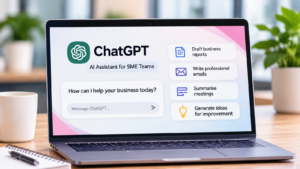
ChatGPT can assist businesses with preparing documents, reviewing information, summarising discussions and organising ideas. For an SME where managers handle several responsibilities, these capabilities can reduce time spent preparing routine communication and administrative material.
For example, a manufacturing manager could use ChatGPT to organise observations from production meetings into a structured report, while a sales team could use it to prepare customer follow-up drafts. However, AI-generated material requires human verification, particularly when it contains technical details, financial information or customer commitments. Businesses should also avoid entering confidential information into tools that have not been approved for that purpose.
2. Microsoft 365 Copilot for Reporting and Office Work
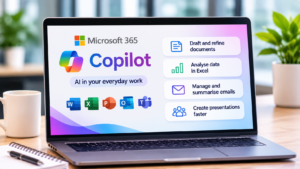
Many SMEs use Microsoft Excel, Word, Outlook and PowerPoint for daily business activities. Microsoft 365 Copilot introduces AI assistance into supported workflows, helping employees work with documents, emails and business information.
A company preparing weekly sales reviews, for example, may use these capabilities to summarise discussions, prepare first drafts and examine information more efficiently. The benefits depend on the features included in its subscription, the quality of available data and how employees use the system. For SMEs already operating within Microsoft 365, evaluating these features may be more practical than introducing an entirely separate platform.
3. Google Workspace with Gemini for Team Collaboration
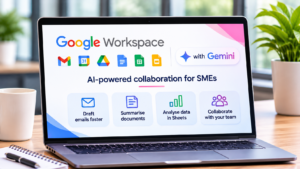
Google Workspace offers AI capabilities through Gemini across supported applications and plans. These features can help employees prepare written communication, summarise information and collaborate on documents.
An FMCG business coordinating with multiple distributors could use AI assistance to organise meeting notes, prepare follow-up messages and review information shared across teams. While this may improve communication efficiency, employees must still verify commercial details, quantities and delivery commitments before acting on the generated content.
4. Zoho CRM with Zia for Sales Management
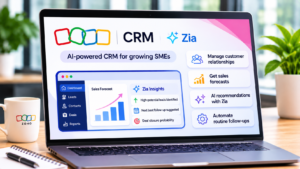
Customer follow-ups can become difficult when enquiries arrive through websites, exhibitions, distributors and direct sales activities. Zoho CRM with Zia provides AI-assisted features that can support sales analysis, forecasting and customer relationship management.
For an industrial equipment supplier, the value may lie in having a clearer view of enquiry history, sales activities and potential opportunities. However, the CRM must contain consistent and updated information for its analytical features to be useful. Introducing AI without establishing a reliable sales process may simply automate existing inefficiencies.
5. Microsoft Power Automate with AI Builder for Repetitive Processes
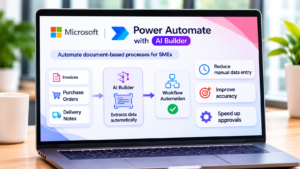
Businesses often spend considerable time handling invoices, purchase orders and other structured documents. Microsoft Power Automate with AI Builder can support document information extraction and workflow automation.
A manufacturing SME receiving hundreds of supplier invoices could evaluate an automated process that captures invoice details and routes them for review. This could reduce repetitive data entry and improve consistency, although extracted information should be validated before being transferred into accounting systems. Such tools are particularly relevant when administrative delays affect operational efficiency.
6. AI-Based Demand Forecasting for Inventory Management
Inventory management directly affects working capital, customer delivery and operational stability. Manufacturing and FMCG companies frequently face the challenge of maintaining sufficient stock without tying up excessive money in materials or finished goods.
AI-based demand forecasting applications can analyse historical sales, demand patterns and other available information to support planning decisions. For instance, an FMCG manufacturer could evaluate whether certain products experience recurring regional or seasonal demand changes. These insights may help teams adjust replenishment plans and reduce avoidable inventory imbalances. Businesses should first explore forecasting capabilities within their existing ERP systems before investing in additional software.
7. AI-Powered Quality Inspection and Predictive Maintenance
Manufacturing SMEs can also explore AI applications that address shop-floor performance. Camera-based inspection systems can help identify certain product defects, while predictive maintenance solutions analyse equipment data to detect abnormal operating conditions.
An automotive components manufacturer experiencing recurring quality issues might evaluate AI-assisted inspection for a specific production stage. However, these solutions are different from general-purpose AI software because they may require cameras, sensors, equipment integration and technical expertise. A pilot should establish whether the system can reliably detect relevant problems under actual production conditions.
How SMEs Can Identify the Right AI Application
Before comparing tools, management should examine which problems are affecting business performance. A company facing poor on-time delivery may initially assume that it needs advanced production planning software. However, further investigation might reveal that unreliable inventory records or frequent machine breakdowns are the primary causes of delay.
Similarly, a business experiencing slow sales growth may not immediately benefit from AI-based lead generation if its existing customer enquiries are not being followed up consistently. Improving the sales process and maintaining accurate CRM records may provide a more useful foundation for AI-assisted sales management.
This is why technology selection should follow operational analysis. Businesses should assess how frequently a problem occurs, its financial consequences, the availability of relevant data and the effort required to implement a solution.
| Business challenge | AI application to consider | What to measure |
|---|---|---|
| Time-consuming reports | AI-assisted reporting | Time spent preparing reports |
| Missed sales follow-ups | AI-enabled CRM | Lead response time |
| Excess inventory | Demand forecasting | Inventory holding days |
| Manual invoice entry | Document automation | Processing time and error rate |
| Recurring machine downtime | Predictive maintenance | Unplanned downtime |
| Quality defects | AI-enabled inspection | Defect and rejection rates |
The most suitable application is the one that addresses a meaningful business problem and can be supported by the company’s existing capabilities.
Practical AI Applications in Manufacturing, Pharma and FMCG
Manufacturing: Improving Productivity and Production Planning
Manufacturing SMEs often face challenges related to equipment utilisation, production scheduling, quality consistency and material availability. AI can assist in examining operational information, identifying recurring patterns and supporting planning decisions.
Consider a precision components manufacturer operating several CNC machines. Production targets may be missed because of frequent changeovers, unplanned downtime or inconsistent material availability. Before choosing an AI solution, the company should understand which factors contribute most to the problem. Once dependable production information is available, analytical tools can support more informed scheduling, maintenance and improvement decisions.
The resulting improvement should be measured through indicators such as machine utilisation, production output, rejection rates and delivery performance. Without these measurements, it becomes difficult to determine whether the technology is improving operations.
Pharma: Supporting Documentation and Process Efficiency
Pharmaceutical manufacturers operate under strict quality and regulatory requirements, making documentation accuracy and process consistency essential. AI-assisted systems may help employees organise records, retrieve information and prepare draft documentation, provided they operate within the company’s approved quality processes.
For example, a pharmaceutical SME could explore AI-supported retrieval of approved standard operating procedures or the organisation of historical quality documentation. However, regulated processes require appropriate validation, traceability, access controls and qualified human review. AI should support authorised personnel rather than replace required quality decisions or approvals.
The business opportunity is therefore not unrestricted automation, but reducing administrative effort while maintaining the necessary controls.
FMCG: Improving Demand Visibility and Distributor Management
FMCG businesses frequently manage multiple product categories, distributors and regional markets. Demand can change because of seasonality, promotions, customer preferences and distribution conditions, making inventory planning more difficult.
An FMCG company could evaluate AI-enabled forecasting to understand how sales patterns differ across products and locations. When supported by reliable sales and inventory information, these insights can help management review stock allocation, replenishment and promotional planning.
The effectiveness of such tools depends on how well the organisation maintains its data and converts analytical findings into operational decisions.
What Does AI Implementation Cost for an SME?
The cost of adopting AI varies significantly depending on the application. General productivity tools may involve monthly user subscriptions, while specialised manufacturing solutions can require additional hardware, integration and technical support.
For example, introducing AI-assisted documentation may require limited configuration and employee training. Implementing predictive maintenance across production equipment could involve installing sensors, collecting machine data, integrating software and monitoring performance over time.
SMEs should therefore consider the complete cost of implementation rather than comparing software subscription prices alone. This includes licensing, integration, data preparation, employee training, maintenance and ongoing support.
A useful way to evaluate the investment is to compare its expected benefits with the current cost of the problem. If employees spend substantial time manually preparing reports, management can calculate the value of reducing those hours. If production losses are caused by recurring equipment failures, the business can estimate the financial impact of downtime and assess whether the proposed solution could realistically reduce it.
An AI investment becomes easier to justify when its expected impact can be connected to measurable operational or financial indicators.
How to Implement AI Tools for SMEs Successfully
A practical AI implementation should begin with a defined business problem and an understanding of current performance. For instance, if the objective is to reduce invoice processing time, the company should first record how long invoices take to process, how frequently errors occur and where approvals are delayed.
The next stage is to review process readiness. Existing systems must be capable of supplying the information required by the proposed application. If important records are incomplete or inconsistent, the business may need to improve data collection before introducing more advanced technology.
Once the requirements are clear, the company can evaluate suitable tools based on functionality, cost, integration, information security and ease of use. Testing the selected application within one process or department helps employees understand its practical limitations before wider adoption.
After the pilot, management should compare performance against the original baseline. If the tool reduces processing time but creates additional errors or requires extensive manual correction, the overall benefit may be limited. Conversely, if it delivers consistent improvements at an acceptable cost, the business can consider expanding its use.
Employee involvement remains important throughout implementation. AI solutions are more likely to deliver lasting value when the people responsible for the process understand how the technology works, where its limitations lie and how their responsibilities may change.
Why AI Adoption Does Not Always Deliver the Expected Results
One of the most common reasons technology investments underperform is that businesses introduce new tools without addressing underlying process problems. A forecasting application cannot reliably compensate for inaccurate inventory records, just as a CRM system cannot independently resolve an unclear sales process.
Another challenge is the gap between technology demonstrations and actual operating conditions. A solution may perform well during a controlled demonstration but encounter difficulties when handling inconsistent data, unusual transactions or changing production requirements.
SMEs should also consider vendor dependence, information security and the cost of supporting a solution after implementation. A system that requires continuous technical intervention may not be appropriate for a business without the necessary internal resources.
Successful adoption therefore depends on more than software selection. It requires suitable processes, dependable information, employee participation and clear ownership of the expected business outcomes.
How nicheBrains Supports AI Adoption and Business Improvement
For many SMEs, the difficulty is not a lack of available technology but uncertainty about what should be improved first. A business may recognise that operational costs are increasing without knowing whether the underlying problem involves production planning, workforce capabilities, outdated systems or inefficient processes.
nicheBrains addresses this challenge through an AI-powered business improvement platform that connects business assessment, relevant expertise and implementation support.
The platform helps SMEs evaluate improvement opportunities across areas such as operations, technology, sales, strategy and organisational capabilities. Based on the identified requirements, businesses can connect with vetted experts who bring relevant industry and functional experience.
This approach is particularly useful when the solution requires more than software installation. For example, improving inventory performance may involve reviewing purchasing practices, forecasting methods, operational workflows and system capabilities together.
By connecting business diagnosis with specialist expertise and implementation, nicheBrains helps SMEs pursue improvements with clearer priorities and measurable objectives.
The Future of AI for Indian SMEs
As AI capabilities continue to evolve, Indian SMEs will have more opportunities to integrate analytical and automation tools into everyday operations. However, access to sophisticated technology alone will not determine which businesses benefit most.
Companies that understand their operational weaknesses, maintain reliable information and develop employee capabilities will be better positioned to evaluate new applications. Others may find that improving existing processes and digital systems is a necessary first step.
For manufacturing, pharma and FMCG businesses, the strongest opportunities are likely to emerge where AI addresses persistent problems involving productivity, quality, inventory, documentation and customer management.
Ultimately, the value of AI should be judged by its contribution to business performance. A smaller, well-implemented solution that produces measurable improvements may be more valuable than an expensive platform introduced without a clear purpose.
For SMEs considering AI adoption, the most important starting point is a clear understanding of their business challenges, the improvements they want to achieve and the capabilities required to make those improvements sustainable.
Explore how nicheBrains can help your business assess its improvement opportunities, identify relevant expertise and move towards practical implementation.
Frequently Asked Questions
Which AI tools are useful for SMEs in India?
SMEs can evaluate tools such as ChatGPT for documentation, Microsoft 365 Copilot for workplace productivity, Zoho CRM with Zia for sales management and specialised systems for inventory forecasting, quality inspection or predictive maintenance. The right choice depends on the business problem.
Can SMEs implement AI without an IT department?
Many productivity applications require little technical expertise, although businesses must still manage security, permissions and employee training. More complex solutions involving ERP systems, manufacturing equipment or sensitive information may require specialist implementation support.
Is AI affordable for small manufacturing businesses?
Some applications are available through relatively accessible subscription models, while industrial AI solutions may involve additional hardware and integration costs. Affordability should be assessed against the expected operational benefits and total cost of ownership.
How can an SME measure the success of AI implementation?
Success should be measured using indicators connected to the original problem, such as reduced processing time, lower defect rates, improved inventory efficiency or faster customer response times. Comparing results against a documented baseline helps establish whether the investment is delivering value.