
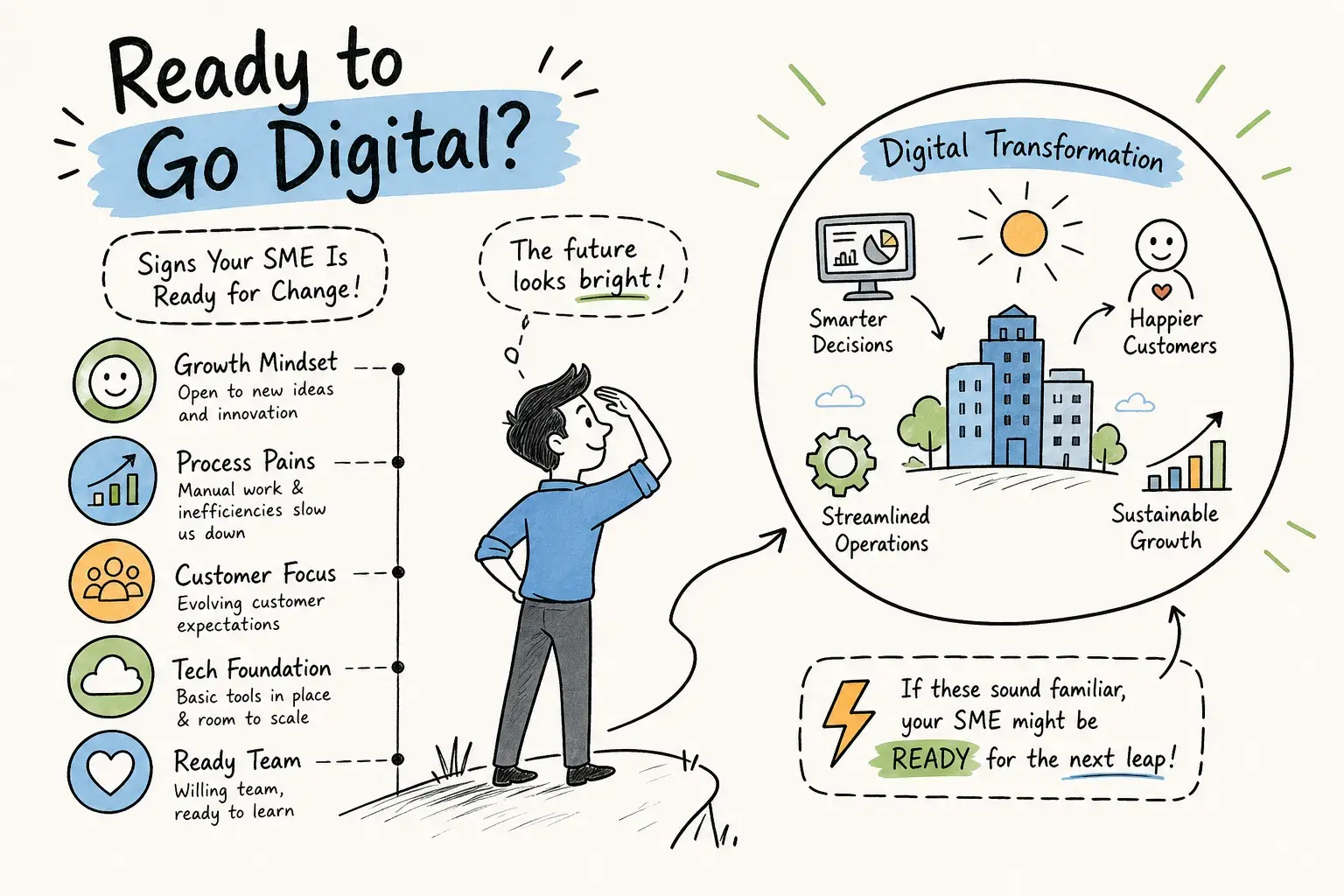
There are three clear signs that an SME is ready for digital transformation: recurring operational failures that keep returning despite previous fixes, leadership that can name a specific measurable outcome they want to achieve, and data sitting in spreadsheets or legacy systems that nobody is using to make decisions. When several of these signals appear together and persist, the business has likely outgrown ad-hoc digitisation and is genuinely positioned to benefit from a structured programme.
For Indian SMEs in manufacturing, FMCG, automotive, and pharma, this question is increasingly urgent. Competitive pressure in these sectors is outpacing internal capability in many businesses, and operational complexity grows with every new distributor, SKU, or production shift added. At nicheBrains, the readiness question is the first thing we assess before any transformation conversation begins. Starting without it wastes money and erodes the goodwill needed to drive change inside the organisation.
Key takeaways
- Readiness, not interest: Wanting to go digital and being structurally ready to do so are different things; the core readiness signals tell you which side you are on.
- Recurring problems signal readiness: If a process problem keeps reappearing despite previous fixes, the issue is structural and demands a proper solution.
- Assessment before tools: digital readiness assessment across five dimensions must precede any tool selection or implementation decision.
- Five-step roadmap: A structured digital transformation programme moves from business case to target model, foundation, pilot, and then governed scale, producing defined deliverables at each step.
- Outcome KPIs from day one: “System launched” is an output; what matters is cycle time, error rate, and adoption measured against a pre-implementation baseline.
- People side is non-negotiable: Treating transformation as a technology project rather than an organisational change programme is the most common reason implementations stall.
Wanting to transform and being ready to transform are not the same thing
What ad-hoc digitisation actually looks like in practice
Most Indian SMEs fall into a familiar pattern: a standalone CRM purchased to manage leads, a separate accounting tool for GST compliance, and a WhatsApp group running informal order management between sales and the warehouse. Each tool solves a narrow problem at the time, but the organisation as a whole becomes harder to manage, not easier. There is no integration between any of them, data conflicts across systems, and the same order detail gets typed in three times by three different people.
This is digitisation, not digital transformation. The distinction matters because the solution is completely different. Digitisation adds tools; transformation restructures how the business operates and how decisions get made.
Why scattered tools make digital transformation harder to build
Ad-hoc tool adoption creates technical debt, resistance to change (“we just learned the last system”), and fragmented data that cannot support decisions at speed. The cost of unwinding these choices is consistently underestimated by SME leadership teams. An SME that recognises this pattern in its own operations is usually closer to transformation readiness than it realises, because it has already experienced the limit of the current approach and is looking for something fundamentally different.
What are the actual signs your SME is ready for digital transformation?
Operational pain points that repeat themselves despite existing fixes
The most telling diagnostic question is: “Have you tried to fix this problem before?” If the answer is yes and the problem keeps reappearing despite those fixes, the issue is structural, not technological. In manufacturing, common examples include production scheduling that breaks down every quarter, inventory that is never accurate at month-end, and supplier payments that require three people to reconcile manually. These recurring failures are among the clearest readiness signals of all: the business has already accepted that change is necessary, and previous partial fixes have run out of road.
Leadership alignment and a defined problem to solve
Readiness is not just operational; it is also behavioural at the leadership level. A business is ready when the owner or MD can articulate a specific, measurable outcome: “reduce order-to-dispatch time from seven days to three” or “cut raw material waste by 15%.” Vague intent such as “we want to go digital” is not a readiness signal. It is the starting point of a discovery conversation, not a transformation programme.
Budget and timeline commitment matter here too. Leadership must be prepared to commit both time and investment, or the programme will stall before it produces results.
You already have data but it is not driving decisions
The third signal: data exists in some form, whether production logs, sales reports, GST returns, or ERP records, but the business is not using it to make faster or better decisions. Management asks for a margin report and waits two days for someone to build it in Excel.
This gap between data availability and data use is one of the most reliable indicators of transformation readiness, because the foundation is already partly built. The problem is not a lack of information; it is the lack of a system that surfaces it at the right moment.
How does a digital readiness assessment give you a clear starting point?
What a maturity diagnostic actually checks across five dimensions
A proper readiness assessment evaluates five areas: processes (how work is done today), data (what exists, where it lives, and how reliable it is), technology (current tools, integrations, and technical debt), people (skills, capacity for change, leadership alignment), and strategy (clarity of outcomes and business case).
Without a baseline across all five, any transformation roadmap is guesswork. A digital maturity assessment is fundamentally different from a standard IT audit, which checks controls and compliance. The maturity assessment asks whether technology is actually improving how the business operates and whether the organisation is capable of sustaining that improvement.
How the AI Digital Readiness Report works and where nicheBrains fits in
This is exactly where nicheBrains comes in. Our AI Digital Readiness Report runs your business through a structured diagnostic that maps your current state across all five dimensions, surfaces the most significant gaps, and produces a prioritised view of where to start. The report also identifies what type of consultant expertise you need, so you are not left searching for help independently or hiring a generalist whose background happens not to match your bottleneck.
Once the report is complete, nicheBrains automatically matches your SME with three to five vetted consultants from our network of 5,000+ certified experts, each selection tailored to the specific gaps the diagnostic identified. This replaces the common alternative: calling someone a peer recommends, receiving a generic proposal, and spending the first three months realigning scope.
The five-step digital transformation roadmap for Indian SMEs
Steps 1 to 3: from strategic clarity to building the foundation
The first three steps are sequential and each produces a defined deliverable. Step 1 is defining the business case: agreeing on measurable outcomes, executive commitment, and baseline KPIs before any technology decision is made. Step 2 is designing the target operating model, mapping what the business should look like at 12 and 24 months across operations, sales, finance, and people. Step 3 is building the digital foundation, which for most Indian SMEs means implementing or integrating an ERP, establishing clean data flows, addressing cloud migration and modernisation where applicable, and setting up reliable cybersecurity and access controls.
Steps 4 to 5: piloting, scaling, and tracking via the progress dashboard
Step 4 is running a pilot on one high-value process. Business process automation applied to production scheduling, collections tracking, or supplier management is a common starting point for manufacturing and pharma SMEs. The pilot tests the approach with real users, measures results, and surfaces adoption problems before the rollout widens. Step 5 is scaling what works and institutionalising change through role-based training and governance, so the new way of working outlasts the initial engagement.
Throughout steps 4 and 5, the nicheBrains progress-tracking dashboard gives both the SME and the consultant a real-time view of milestones, KPIs, and deliverables. This solves one of the most common frustrations in transformation programmes: progress becomes invisible after the kickoff meeting, and nobody knows whether the initiative is on track until something goes wrong.
What do results look like at 6, 12, and 24 months?
Transformation KPIs that Indian SMEs actually track
The KPI categories most relevant for manufacturing and pharma SMEs span operational efficiency (cycle time, error rate, throughput), financial return (cost savings, inventory reduction, order-to-cash improvement), and digital adoption (the percentage of target users actively using the new system within 90 days of go-live). Industry benchmarks suggest basic digitisation can produce measurable benefits within 3 to 6 months; operational improvements typically become clear within 6 to 12 months; and fuller financial payback generally follows in the 12-to-24-month window.
“System launched” is an output, not an outcome. The nicheBrains progress dashboard tracks outcome KPIs from day one, not just delivery milestones, so the SME can see whether the investment is producing real business value rather than just completed tasks.
Mistakes that derail SMEs who skip the readiness check
Choosing tools before defining the outcome they need to achieve
The most common mistake is an SME seeing a peer install a particular ERP or CRM and buying the same product without assessing whether it addresses their specific bottleneck. The tool may be technically sound but wrong for the problem at hand. Industry data indicates that implementation, data migration, integration, and training can cost up to three times the software licence fee. Choosing the wrong tool is therefore not just a mismatch; it is an expensive mistake to reverse, often consuming the entire first-year budget on a solution that does not address the original pain point.
Underestimating the people side of digital adoption and organisational change management
The second major mistake is treating digital transformation as a technology project rather than an organisational change programme. Leaders must model the new behaviour consistently; managers need training to coach teams through the transition; and quick wins must be made visible early to build momentum across the organisation. Without active change management, even technically sound implementations stall at adoption: the system goes live, usage falls away if adoption is not actively managed, and the project is quietly declared complete while the original problem persists.
At nicheBrains, our vetted consultant network covers operations, supply chain, technology, and workforce-skills expertise. The platform matches SMEs with the full range of expertise their diagnostic identifies, so the people side of transformation gets as much structured attention as the technology side.
Start your digital transformation with a diagnostic, not a tool purchase
The signs of readiness are not about having advanced technology in place already. They are about having recurring problems that demand a structural fix, leadership that can name a specific outcome, and enough data to build on. When those signals are present and persistent, the right next step is a structured digital readiness assessment, not a software selection process.
Treat the assessment as the real starting point of your digital transformation, not a preliminary formality. It tells you where you are, what matters most, and which expertise you need. nicheBrains turns the readiness report into a matched consultant recommendation and a managed roadmap, so you are not navigating the process alone.
If you recognise several of these readiness signals in your business, you have enough to start the diagnostic today. Reach out to our team to run the AI Digital Readiness Report and get a prioritised view of where your transformation programme should begin.
Frequently Asked Questions
How do we know if a recurring operational problem is structural or just bad luck?
If you have tried to fix the problem before and it keeps reappearing, it is structural rather than random. In such cases previous partial fixes have run out of road and the issue demands a proper transformation rather than another point solution.
We have already bought several standalone tools, are we still ready for a transformation programme?
Yes, an SME with scattered tools is often closer to transformation readiness because it has hit the limits of ad-hoc digitisation and faces technical debt and fragmented data. In that situation a readiness assessment helps prioritise unwinding past choices, address integrations and data flows, and define a roadmap that fixes structural issues rather than adding more point solutions.